
She's Argentine, and the UN honored her for a creation with high social impact
María Fernanda Bonesso showing her father, Miguel Ángel, the app she created. It was a November afternoon when, while María Fernanda Bonesso, from Mendoza, was finishing her graduate thesis in Buenos Aires…
Published in La Nación on August 13, 2021
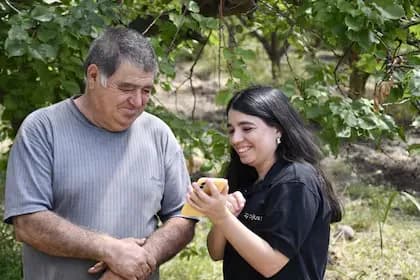
María Fernanda Bonesso showing her father, Miguel Ángel, the app she created
It was a November afternoon when, while María Fernanda Bonesso, from Mendoza, was finishing her graduate thesis in Buenos Aires, her parents Miguel Ángel and Mónica were struggling in Maipú to sell the apricots from their farm, because they had “halted the harvest”: the price per kilo they were being paid wasn't even enough to cover the pickers' wages. A desperate call from her mother in Mendoza was the trigger that made the young woman realize something had to be done for small producers in the regional economies.
“I remember from when I was very young that every November there was tension at home because the apricots had to be sold, and doing it quickly was always very difficult. My parents had a knot of anxiety in their stomachs when the time came to sell that early fruit. The same happened with other crops we grew at other times, like tomatoes and olives,” she tells LA NACION.
That's how she understood that the marketing system had to change, because there was no relationship between the price the producer sold at and what consumers paid in the markets. If something wasn't done soon, sooner or later, because of high costs, small and medium-sized farmers wouldn't hold out and would end up disappearing.
As a teenager, when she went with her father to the farm, she always wondered why the production of fruits and vegetables wasn't valued, when it was ultimately food for the world. Yet, consciously or not, as soon as she finished high school she headed far from that place to study Economics and later some graduate programs in Spain and Buenos Aires.
“Even though it was something I really liked and had enjoyed so much as a girl, something pushed me away from here. Maybe having seen my parents' suffering and anguish for so long drove me away,” she says.
She knew the solution lay on the technology side. There was a major logistics problem that needed fixing. “That was my bridge to change that reality. These markets had to be connected,” she points out.
At the end of 2018 she recruited tech talent to spend a year building the app for the agricultural sector. That's how Agrojusto was born, a platform dedicated to digitalizing agri-food businesses. Today, the small company has 12 professionals on board, and more than 100 food producers from across the country are on the platform: Misiones, Jujuy, Río Negro and Mendoza, among other provinces. They also provide digital training to farmers so they know how to find their way around the website.
On the other side of the counter, there are more than 340 retailers who interact and buy through the same online platform across the country. In addition, home deliveries are very simple, since a delivery route sheet is generated.
Programs and awards
Another of her achievements was building alliances with organizations such as INTA (Argentina's National Institute of Agricultural Technology) to prepare and train producers so they can use the tool easily. “We have programs in rural schools, where INTA opened up its contact networks to us. It's very important for us to plant the seed in the kids, who are the children of producers who are often reluctant to learn how to use this kind of technology,” she explains.
For Bonesso, they are the agents of change who can stop the exodus from the countryside to the city and help people stay in rural areas by embracing technology. “It's young people who need to tell their parents that there's another way to sell their products, and that it isn't just standing for more than 10 hours at a market stall,” she says.
Also, in 2021, her small business was selected by the United Nations (UN) from among 2,000 applications worldwide as one of the 50 best small businesses in the “Best Small Business: Good Food for All” competition, held alongside the organization's Food Systems Summit. “It made us very proud to receive this recognition, which drives us to keep growing,” she concluded.